

Recently, in response to a media query regarding Taiwan Authorities’ “Postponement of Lai Ching-te’s Visit” to Eswatini, the Spokesperson of Chinese Ministry of Foreign Affairs noted that there is but one China (the People’s Republic of China) in the world and there is no longer a so-called “president of the Republic of China” anymore. Lai Ching-te’s attempt to conduct “visits” under this false title in pursuit of “Taiwan independence” openly contravenes the one-China principle, and such schemes are against history and will only invite disgrace upon himself. All African countries, with the sole exception of Eswatini, have established diplomatic ties with China. These 53 countries together with the African Union have adopted the Beijing Declaration at the 2024 FOCAC Summit and have reiterated on many occasions that they firmly uphold the one-China principle. The commitment of relevant countries to the one-China principle is fully consistent with the international law and the basic norms of international relations.
Taking this occasion, and in light of the latest developments in relations across the Taiwan Strait, I wish to further brief Mauritian friends on the historical context of the Taiwan question and the essential meaning of the one-China principle.
Taiwan has belonged to China since ancient times. This statement has a sound basis in history and jurisprudence. Early in the year of 230 AD, Chinese historical documents already contained references to Taiwan. From the 12th century onward, successive Chinese central governments have set up administrative bodies to exercise jurisdiction over Taiwan. This continued until 1895, when Japan seized Taiwan through war. After the victory of the World Anti-Fascist War, the Cairo Declaration, the Potsdam Proclamation, and the Japanese Instrument of Surrender, all of which carry binding international legal effect, explicitly stipulated that Japan should return to China all the territories it had stolen from China, including Taiwan. In 1949, the Chinese people overthrew the government of the Republic of China(ROC) led by the Chinese Kuomintang (KMT) party, renamed the country the People’s Republic of China(PRC), and established the Central People’s Government of the People’s Republic of China. The P.R.China became the sole legitimate government of the whole of China and thus fully enjoys and exercises China’s sovereignty, including sovereignty over the Taiwan region. Although the unresolved civil war and foreign interference have left the two sides of the Taiwan Strait in a prolonged state of political confrontation, the sovereignty and territory of China have never been divided and the fact that Taiwan is an inalienable part of China’s territory has never changed.
At its 26th session in October 1971, the United Nations General Assembly adopted Resolution 2758 with an overwhelming majority. UNGA Resolution 2758 solemnly confirms and fully embodies the one-China principle, making it clear that there is but one China in the world, the Taiwan region is an inalienable part of China’s territory, and the Government of the People’s Republic of China is the sole legitimate government representing the whole of China. To date, 183 countries including Mauritius have established and developed diplomatic relations on the basis of the one-China principle with the People’s Republic of China and the one-China principle has become a basic norm of international relations and a prevailing consensus in the international community.
The Chinese nation has a civilization spanning over 5,000 years. People on both sides of the Taiwan Strait belong to the Chinese nation and have jointly created this splendid Chinese civilization as well as forged the shared belief that “the territory cannot be divided, the country cannot be destabilized, the nation cannot be separated, and the civilization cannot be interrupted”. The fundamental status quo of Taiwan Strait is that both sides of the Strait belong to one and the same China, and the biggest threat to peace and stability in the Taiwan Strait is “Taiwan independence” forces’ separatist activities and external connivance and support for these activities. The current tensions across the Taiwan Strait are fundamentally caused by the authorities of Taiwan under Lai Ching-te and the Democratic Progressive Party (DPP), who adhere to separatist “Taiwan independence” positions, deny the one-China principle, sever cross-Strait links, promote “de-Sinicization”, attempt to deny the basic fact that people on both sides belong to the same Chinese nation and are all Chinese, and persist in seeking external support for “independence”. Under the deliberate manipulation of the DPP authorities, cross-Strait exchanges have sharply declined, and the people in Taiwan are bearing the consequences, with a strong aspiration to restore exchanges and return to stability.
Few days ago, Cheng Li-wun, chairwoman of the Chinese Kuomintang (KMT) party led a delegation to visit China’s mainland. Dialogue and exchanges were carried out on the common political foundation, which is upholding the 1992 Consensus (On 1992, the two sides across the Strait agreed that the mainland and Taiwan belong to one China) and opposing “Taiwan independence”. This visit responds to the prevailing public aspiration in Taiwan for peace, development, exchanges, and cooperation. When meeting with Chairwoman Cheng in Beijing, President Xi Jinping, General Secretary of the Central Committee of the Communist Party of China, emphasized that no matter how the international landscape and the situation across the Taiwan Strait may evolve, the overarching trend toward the great rejuvenation of the Chinese nation will not change, and the prevailing momentum for the Chinese on both sides of the Strait to come together will not change. He expressed the willingness to strengthen exchanges and dialogue on the basis of the common political foundation of adhering to the 1992 Consensus and opposing “Taiwan independence”. The Chinese mainland then rolled out a package of 10 policies and measures—spanning inter-party communication, youth exchange, trade and culture—aimed at boosting exchanges and cooperation with Taiwan, fully demonstrating the sincerity and goodwill of the Chinese mainland in promoting the peaceful development of cross-Strait relations.
China and Mauritius enjoy a long-standing traditional friendship and it will mark the 55th anniversary of the establishment of diplomatic relations next year. In 1972, the late Prime Minister Sir Seewoosagur Ramgoolam of Mauritius, in line with the prevailing international trend, made the political decision to establish diplomatic relations with the People’s Republic of China, opening a new chapter for our bilateral relations. Successive Mauritian governments have consistently upheld the one-China principle, which reflects a firm commitment to the basic norms of international relations and international law. Both China and Mauritius firmly safeguard national sovereignty and territorial integrity, and have made unremitting efforts to this end. China stands ready to work with the Mauritian side to continue firmly supporting each other on issues concerning respective core interests and major concerns, jointly safeguard the international system with the UN at its core and the international order based on international law, as well as promote respective national development and advance the building of a community with a shared future for humanity.
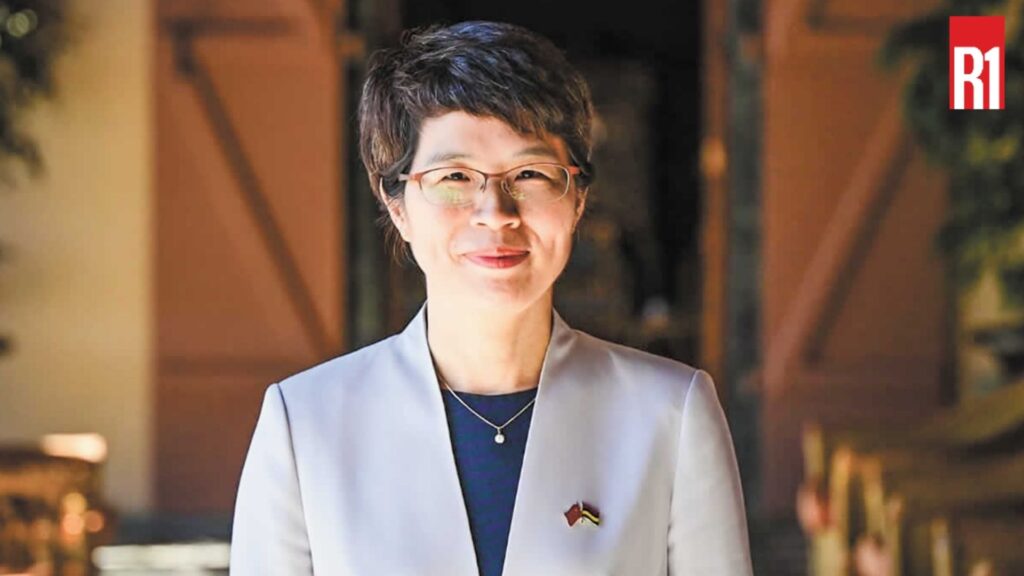
By H.E. Dr. Huang Shifang,
Ambassador of the People’s Republic of China to the Republic of Mauritius